
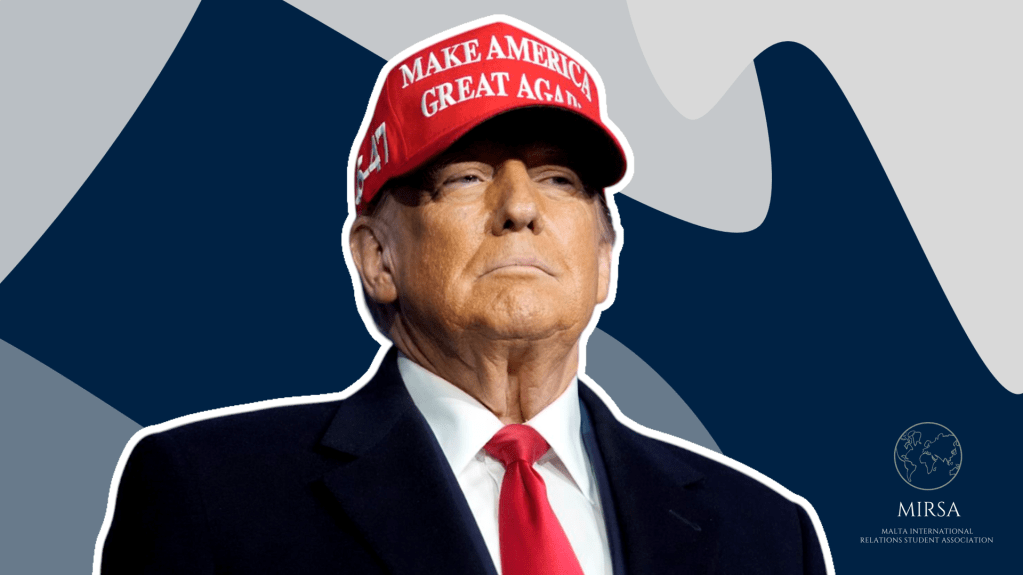
Donald Trump’s return to presidency has sparked intense discussions about the potential implications for U.S. foreign policy across various global issues. His “America First” doctrine, often prioritising national interests at the expense of international alliances, raises questions about the future of U.S. global relations. Trump’s approach suggests a shift towards a more transactional foreign policy, where military and economic support may be contingent upon financial contributions from allies. Additionally, his stance on climate change and immigration indicates a willingness to reverse many of the progressive policies that have shaped recent U.S. governance. As we explore these themes, it becomes crucial to understand how Trump’s policies could reshape not only American foreign relations, but also global dynamics in the coming years.

Trump on Ukraine
The twice-elected US president has never held back when voicing his views, and he is not holding back on the Ukraine problem either. Trump has frequently lambasted the expense of aid to Ukraine, implying that he would like to see the war resolved quickly. He has placed more emphasis on mediating a peace deal than gaining a decisive Ukrainian victory over Russia, implying that if re-elected, he could reach a resolution in as little as one day (Politico.eu). Trump has also hinted that if Kyiv does not pursue peace talks, he may put pressure on Russia and Ukraine to come to a deal, maybe by restricting future funding to Ukraine. Furthermore, Trump’s stance diverges considerably, as he has promised to prioritise an “America First” approach. His policies prioritise advancing national interests over spending excessively on foreign matters that detract from America’s economy, security, and overall dominance (KPMG).

US Trade with China
With Donald Trump’s re- election, American trade policy with China is set to intensify under a more aggressive “America First” agenda. Trump has proposed high tariffs on Chinese imports (potentially up to 60%) to pressure China into addressing trade imbalances and to restore U.S. manufacturing by reducing dependency on Chinese goods. Trump’s strategy is expected to intensify the U.S.-China economic separation and could lead to increased production costs for U.S. businesses, potentially impacting American consumers through higher prices on imports. The Phase One Trade Deal from Trump’s first term, which obliged China to purchase more U.S. goods, largely failed to meet targets, resulting in trade tensions and limited impact on the U.S. economy. Many analysts believe that Trump’s proposed tariffs could further disrupt global supply chains, pushing more companies to relocate manufacturing out of China. This approach could result in a fundamental reshaping of global trade dynamics, with the U.S. taking a more nationalistic mindset, potentially affecting other economies reliant on stable U.S.-China trade.

Taiwan and Military security
The United States and Taiwan have always had a special relationship, characterised by a certain strategic ambiguity and grounded in an unofficial alliance. Under a renewed Trump presidency, Taiwan’s military security may face a more transactional U.S. approach, potentially requiring Taiwan to increase its financial contributions to secure American support. Trump’s America First policy could signify heightened pressure for Taiwan to increase its defence spending and spend more on U.S.-made military assets. Trump’s stance may also reinforce the longstanding U.S. policy of strategic ambiguity towards Taiwan, where support is implied but not guaranteed. Although Trump demonstrated a willingness to support Taiwan through arms sales, he emphasised the challenges to defending Taiwan due to long distance and a lack of U.S. obligation to intervene militarily in conflicts that do not directly benefit American interests. Trump’s unpredictable character and approach could introduce greater uncertainty about direct military involvement in case of an attack on Taiwan by China, which will most likely lead to Taiwan shifting towards a more self-reliant defence strategy.

Climate Change Treaty Compliance
When taking a look at Trump’s proposed foreign policy for his White House term, with reference to climate proposals, it is identifiable that he is aspiring to be a prominent emitter of greenhouse gases. In fact, his “policy proposals […] and thinktanks advising his campaign” outline how to eradicate the nation’s objectives toward the environment and climate. Indeed, as per environmental policy experts Stephen Lezak and Barbara Haya, Trump plans to “fire experts in government,” and would fill in their void by personnel who would applaud the “‘drill, baby, drill’ mentality”. Moreover, Trump proposes to remove the U.S. from the 2015 Paris Agreement. This would be the second time that the world witnesses such an act, after the first Trump Presidency. During this time round, without the vital support from America, other states would not manage to restrict global warming, preluding to “an international race to the bottom”. Furthermore, states could fault their inaction on the lack of US support, rather than “their own lack of ambition”. Additionally, Trump claims to remove Biden’s electric-vehicles mandates together with other policies targeted at lowering emissions. All in all, Trump’s niche foreign policy on climate change clearly shows his lack of belief in this global issue, opting to continuously perceive it as a “scam”.

U.S. troops to be tasked with curtailing Mexican drug cartels?
In 2022, 108,000 American citizens died from drug-related overdoses, those including medical and synthetic opioids. Although this number decreases incrementally every year, the U.S. is still in need for better healthcare regulations and increased funding in law enforcement task forces. This strong rhetoric of “war on drugs” is especially championed by the President-elect, Donald Trump. This links to the false claim that immigrants are at fault for smuggling drugs across the border, since in fact, it is overwhelmingly American citizens who do that. It seems that the idea of sending special troop units to Mexico to fight off cartels, is edging onto the foreign policy agenda for Trump’s administration. However, there are some tactical and strategic challenges to this idea. Firstly, Mexico’s security services would be unwilling to cooperate, especially in gathering information on underground cartel operations. If the United States approaches this situation as a “war,” the cartels are likely to respond, escalating their violence and potentially targeting U.S. drug-enforcement agents. This ties to the over-all reimagining of the military as an all-powerful tool to deploy on American soil.
Immigration
While immigration had already occupied an important place in Trump’s 2015 electoral campaign, the newly re-elected President’s vision of immigration and new promises raise concerns about possible breaches of civil rights and humanitarian obligations. Indeed, Trump’s immigration plan involves eight major key elements to reduce what the newly elected president defines as a threat “poisoning the blood of our country”.
Mass deportation is the first point in this massive immigration plan, the republican president bragged about his ambition to carry out the largest domestic deportation operation in American history. This could lead to the deportation of an estimated 11 million undocumented immigrants currently on American territory. Mass deportation would be followed by workplace raids, targeting key industries known for employing illegal workers, creating a climate of fear within the immigrant communities.
During his campaign, Trump put emphasis on how such measures would benefit American workers by increasing their wages, creating new jobs, however, economists have warned that the sudden removal of a consequent part of the labour force would result in economic disruptions.
Donald Trump did not forget about his 2015 project of building a wall at the border with Mexico, as the newly re-elected president promised to complete the border wall by redirecting military fundings, an increase of border agent patrols was also mentioned. The campaign however, failed to clarify how the latter would be funded.

Finally, the republican administration promised to end birthright citizenship which is nowadays guaranteed by the US constitution. Such an act is defined as unconstitutional by a great number of scholars and would likely be fought by opponents all the way to the Supreme Court of a current republican majority.
End of work visas, the travel ban for Muslim-majority country, revocation of student visas, a return to the “remain in Mexico” policy; these are all measures which were mentioned repetitively during the campaign and constitute a risk for illegal migrants already on American soil, but also future migrants wanting to integrate within American society, underlining Trump’s desire to create a turning point in American immigration policies.
NATO and Europe’s military security
Donald Trump’s foreign policy regarding NATO, Europe, and the war in Ukraine, reflects a significant shift towards a more transactional and sceptical approach. His “America First” doctrine prioritises U.S. interests, often at the expense of long standing alliances.
Trump has consistently criticised NATO allies for not meeting the defence spending target of 2% of GDP, suggesting that U.S. support may be contingent on their financial contributions. This has raised concerns among European leaders about the future of transatlantic security cooperation. Reports indicate that Trump may seek a “radical reorientation” of NATO, where the U.S. would maintain air and naval capabilities. In turn, shifting ground responsibilities to European nations, potentially undermining the alliance’s collective defence principle.

In relation to Ukraine, Trump claims he could end the ongoing conflict but as of yet, has not stated a clear strategy. According to what has been said, he would prefer for Ukraine to suspend their NATO application, which in action would allow the U.S. to continue their military aid. Although this has been said, it is not set in stone as Trump’s current strategy is still unclear, a move that critics argue could compromise Ukraine’s sovereignty and embolden Russian aggression. Trump’s past interactions with Russian President Vladimir Putin have led to accusations of being overly accommodating towards Russia, raising alarms about European security amid ongoing hostilities in Ukraine.
Overall, Trump’s foreign policy vision suggests a departure from established norms in favour of a more unilateral and pragmatic approach, which could reshape U.S.-European relations and impact global geopolitical dynamics.
Conclusion
In conclusion, the implications of Donald Trump’s presidency extend far beyond domestic borders, potentially altering the landscape of international relations significantly. His focus on an “America First” strategy may lead to a rethinking of alliances and commitments that have defined U.S. foreign policy for decades. As Trump navigates complex issues such as military support for Ukraine, trade relations with China and climate agreements, the consequences of his decisions will resonate across the globe. The upcoming years will be critical in determining whether Trump’s approach will foster a new era of U.S. leadership or contribute to increased geopolitical tensions and instability.
Bibliography
Badlam, J. et al. (2022). ‘The Inflation Reduction Act: Here’s what’s in it,’ McKinsey & Company, 24 October.

Bateman, T. (2024). What Trump’s win means for Ukraine, Middle East and China, BBC News.

Davenport, C. and Friedman L. (2024). ‘What Trump’s Victory Means for Climate Change,’ The New York Times.

Girard, B. (2024). If Trump wins, what will his China policies be?, The Diplomat.

Joselow, M. (2024). ‘Hours after Trump win, Biden moves to limit oil drilling in Arctic National Wildlife Refuge,’ The Washington Post.

Lai, S. (2024). Scholars divided on U.S. military support for Taiwan under Trump presidency - Focus Taiwan.

Lezak, S. and Haya, B. (2024). ‘US election: Trump is threatening to turn back the tide on America’s environmental laws and reverse climate progress,’ The Conversation.

Marley, J. (2024). ‘Climate crisis: what Trump can (and can’t) do,’ The Conversation.

Mitra, M. (2024). ‘The Economic Impact of Donald Trump’s Presidency,’ Investopedia.

Oliphant, J. (2024). ‘What are Trump's policies on trade, immigration and other key issues?,’ Reuters.

Reguant, T. (2024). Biden, Trump: Beyond the ‘strategic ambiguity’ towards Taiwan - Global Affairs.

Rosenberg, M. (2024). What a Trump presidency will mean for Europe's economy.

Song, L. (2024). What Donald Trump’s victory means for China, ING Think.

Thompson, J. (2024). Trump’s approach to Taiwan ‘unpredictable’: Scholars - Focus Taiwan.

U.S. Fish & Wildlife Service (n.d.). ‘Arctic National Wildlife Refuge.’

Yeh, J. (2024). Taiwan needs to be ready if Trump re-elected: Scholars - Focus Taiwan.

Yu, M., Lai, S., and Wei, S. (2024). Taiwan faces pressure to boost military spending after Trump win: Experts - Focus Taiwan.
The views expressed in this article are those of the author/s and do not necessarily represent a position or perspective of this or any organisation

Written by: MIRSA Malta
Have an interest, an idea, or an opinion?
Do you have an interest you’d like to tell others about? Or an opinion you’d like to share with the world? From politics to culture and sports, message us if you would like your articles published!
Follow us through our newsletter.
You will only receive an email when we post a new article.
 Bird's Eye View